Look carefully, and you'll notice that I've failed miserably at even beginning to keep this place in-any-way current since sometime before Thanksgiving--and that prior even to that, I'd failed just as miserably for some time before. Well, this is because...
BAD NEWS: ...my computer (well, my old computer, at this point) didn't really work very well for several months. However, I recently purchased a brand new one, which means...
GOOD NEWS: ...I now have a functional computer again.
BAD NEWS: But that means I have to figure out how to recap the past two months or so.
I'll think on it. You might just be getting another list. Sorry.
16 January 2010


23 November 2009
Where did you go to?
OK: remember a while ago, when I posted a whole bunch of different titles and assured you that I would, eventually, get around to posting reviews as well? Not going to happen. You see, my computer's been somewhat on the fritz for what, like a month now? I've been scraping by, but breaking a lot of promises in the course of doing so. Anyway, I'm giving up on all that shit at this point. Here's a list of stuff I read and how much I liked it...
-John Pelan & Benjamin Adams, eds.: Children of Cthulhu- Chilling new tales inspired by H.P. Lovecraft (B)
-Ray Bradbury: The Halloween Tree (A+)
-Peter Ackroyd: Hawksmoor (A-)
-Stanislaw Lem: The Chain of Chance (A)
-Ingvar Amjorsen: Elling (A+)
-David Lodge: Changing Places (A)
-Massimo Carlotto: The Goodbye Kiss (A+)
-James Carville: Forty More Years (B)
-Alan Furst: The Foreign Correspondent (B+)
That's all you're getting, seriously.
-John Pelan & Benjamin Adams, eds.: Children of Cthulhu- Chilling new tales inspired by H.P. Lovecraft (B)
-Ray Bradbury: The Halloween Tree (A+)
-Peter Ackroyd: Hawksmoor (A-)
-Stanislaw Lem: The Chain of Chance (A)
-Ingvar Amjorsen: Elling (A+)
-David Lodge: Changing Places (A)
-Massimo Carlotto: The Goodbye Kiss (A+)
-James Carville: Forty More Years (B)
-Alan Furst: The Foreign Correspondent (B+)
That's all you're getting, seriously.
25 October 2009
Peter Ackroyd: THE TRIAL OF ELIZABETH CREE
 I mean it this time: once the tortuously long and painful saga of my car getting inspected is over and done with (they forgot to switch the stickers, and apparently need me to wait twenty-four hours in order for a manager to do that?), I actually will update these posts to include actual reviews, rather than just promises. And I mean that. I promise.
20 October 2009
David J. Skal: DEATH MAKES A HOLIDAY- A CULTURAL HISTORY OF HALLOWEEN
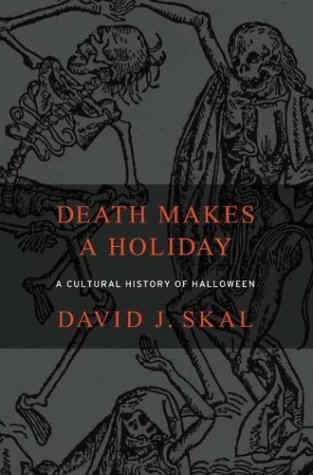
Review forthcoming; check back soon.
18 October 2009

15 October 2009
Robertson Davies: FIFTH BUSINESS (& Happy Canadian Thanksgiving!)
 There's an interesting trend emerging here: around Canada Day this summer, I elected to read a book by Canadian writer Robertson Davies--The Manticore. Come Canadian Thanksgiving just this Monday, I was making my way into another Davies novel, from the same trilogy of books--Fifth Business. I wonder... should I just go for it, and read the final book in the trilogy (World of Wonders) around Statute of Westminster Day in December? To be honest, I most likely should, and probably will (unless my annual winter Dickens gets the way, which it very well might. Funny story: I read more than half of David Copperfield curled up on the chilly tile floor of a poorly-heated Budapest bathroom, following my ingestion of some excellent but apparently tainted nut roll outside the Hungarian parliament [largest parliamentary building in all of Europe, I might add]. Like I said, just a funny story, has nothing to do with this entry-review-whathaveyou). Anyway, let's get back to Fifth Business, a book read largely in snippets on my breaks at work, over lunches, and once sitting in the car on Route 73 in New Jersey waiting for a drawbridge to close. I won't bother going into what the "fifth business" is--you'll learn in time, should you choose to read this book. Not much time, either, as you find out essentially before beginning to read the actual story. But listen: go back a few months, and check out my review of The Manticore, because this is much the same story, retold from a different perspective and thus with different emphases, but much the same story nonetheless. It answers a few more questions than The Manticore, and opens up a few more as well, some of which will no doubt be answered in World of Wonders (again, just another aspect of the same tale). An important point about this book: to be entirely honest, despite my being a bit confused whilst reading The Manticore, and despite its actually being the second book in this trilogy (and Fifth Business the first), if I had to do it over again, I'd still read The Manticore first, to be followed by Fifth Business. This would not only leave the mystery of The Manticore intact, it would also make the revelations to be found in Fifth Business that much more revelatory. A+ for this book, most definitely. It comes highly recommended by me.
10 October 2009
Neil Gaiman: NEVERWHERE
 It was with a certain sense of trepidation that I first approached Neil Gaiman's work. I'm not sure why, but I'm inclined to think it has something to do with his popularity. It's not that I'm so pretentious I can't stand to read anything that's even the slightest bit popular; I've gone cover-to-cover on all the Harry Potter series, two Dan Brown novels (if you can call them that), and even read the first Twilight book (was it called Twilight? I think so...). While I'm at it, I might as well admit to a more-than-passing familiarity with even Mitch Albom's prose. So it's not that I object to reading popular fiction--it's just that so much genre fiction these days is just trash, and the ignorant masses (I'm being semi-ironical here, please note) can't seem to separate the wheat from the chafe, or however that idiom goes. The truth of the matter is, I was quite concerned that Mr. Gaiman's writing would just be bad, something like the inexplicably-popular Stephen King's (how do people read that tripe? Do they, or do they just buy it?). Fortunately, it was not. I pounded back the first three volumes of the collected Sandman (still waiting to get my hands on my father's copy of volume four to finish the set, at which point I'll write it up glowingly here), read and reviewed American Gods sometime during the month of August, and just recently finished enjoying Whatever Happened to the Caped Crusader? earlier this week. By the time I sat down to read Neverwhere, I expected to like Gaiman's writing. I wasn't disappointed. Is this his absolute best work? No, not that I've read. In fact, it's an awful lot like plenty of other late-twentieth, early-twenty first century, but really good. Hidden world underneath London? It's not groundbreaking, but the story is well-told and the stock characters artfully employed. Any cheap hack could've written this story, but because that hack turned out to be Neil Gaiman, the story turned out excellently and the book thoroughly enjoyable. B+ material, this, but solid B+. This is a book I read quickly, without feeling terribly sorry to put it down. It was, in the best way possible, nothing more and nothing less than pure fun. I like that, now and then (it's possibly worth noting that there's a BBC2 television series associated with this book. I know nothing about that, but figured it was still worth noting, at least).
04 October 2009
Alan Paton: TOO LATE THE PHALAROPE

Before I start to tell you about how much I loved this book, I'd like to spend a little while discussing something completely inconsequential. In the early 1960s, the publishing house Charles Scribner's Sons issued a series of trade paperbacks under the banner of "The Scribner Library." Featured authors included F. Scott Fitzgerald, Ernest Hemingway, C.P. Snow, Edith Wharton, Thomas Wolfe, and Alan Paton. Both the Paton novels I've read--Cry, the Beloved Country on a trip to Pittsburgh with my father during my senior year of high school, and now this one, Too Late the Phalarope--have been Scribner Library editions, and this might be one reason why I like Paton so much: because these editions are, without a doubt, my favorite-looking books. I don't really know why (you can judge for yourself, the image at the left looks exactly like the copy I read), but there it is. I don't think that's the only reason, however, because Paton is also one hell of a writer. I don't exactly remember, but I'm pretty sure I cried whilst reading Cry, the Beloved Country, and I almost did as I was finishing Phalarope. It's the story of one man and his family's destruction. The man is Pieter van Vlaanderen, a South African police lieutenant, rugby star and all-around great guy, making his destruction all the more sad yet all more inevitable. Narrated by his aunt, this novel has all the tragedy of, well, a classic tragedy. It's A+ literature if I've ever read it, and possibly even capable of ousting Graham Greene's The End of the Affair as the best literary depiction of human guilt I've ever read. Read it, please read it. Or something by Paton. And if you absolutely refuse to, at least look at it and tell me you like it's attractive design.
01 October 2009
Ian Rankin: DARK ENTRIES

It's been quite a while since I've posted a review one of the comic books I've read, and I'm almost sorry that I've that it's this graphic novel to signal their return. Ian Rankin's Dark Entries is billed as "a John Constantine novel." It's not, as I had initially expected it to be, anything that actually appeared in the Hellblazer comic, but a stand-alone item. It's also not very good. The plot is uninspired, to my feeling, and the whole thing reads, well...cheap. That's it, it all seems very cheap. I wouldn't know Ian Rankin from Adam, and I've even thought about reading anything else he's written, but I can tell you now that I never will. I mean, really: I know the British love them some Big Brother, but to set a Big Brother-style gameshow in Hell--I don't know, I really don't know. To be fair, I'm not super-familiar with Hellblazer, but what I have read has been much better than this. I thought about giving it an F, but it wasn't really quite that bad. So let's call it a D, and never speak of this again.
David Lodge: THE BRITISH MUSEUM IS FALLING DOWN

There are certain books, certain very Catholic books, about which I've often wondered: "Do non-Catholics get this? Would I be enjoying myself quite as much had I been raised in a different faith?" I'm less sure than ever after having read David Lodge's send-up of Catholicism and academe in 1960s Britain, The British Museum is Falling Down. Laughing at the book's Catholicism was, in a way, laughing at myself and my...heritage, if you will. I can't say that I'd've enjoyed a send-up of, say, Methodism quite as much--but then, I can't say that I wouldn't have, either. I just don't know. At any rate, I found The British Museum is Falling Down to be quite, quite entertaining. It's the second book of Lodge's I've checked out from the library recently, but the first proved to be no-go: it was quite long, and called for more of a commitment than I was willing to make without having sampled some Lodge, first. Now that I have, though, I can assuredly say that I will be reading more David Lodge in the future. He reminds me--particularly in the way he mocks the academic establishment--of a young Kingsley Amis, whom Lodge acknowledges as a strong shaping influence on his work (Amis even comes up in this book, which seems to me to draw fairly deeply from Lodge's own life). This book's plot takes its impetus from the Catholic position on birth control, and the concern that position elicits in its main character, Catholic graduate student Adam Appleby. Already the father of three, Appleby fears that his wife may be pregnant yet again, and this concern drives the rest of the book's action, all of which takes place during a single exciting day. I like this A-grade book--but then I'm a Catholic who's not afraid to laugh at Catholicism. Whether or not that's the only reason I like it remains to be seen, but I probably won't find out until I've read more Lodge.
28 September 2009
Arkadi & Boris Strugatski: MONDAY BEGINS ON SATURDAY
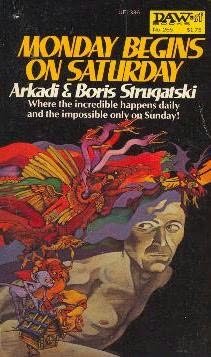
There seems to be something of a general rule that Russian and Slavic fantastic literature is among the most fantastic out there, and the Strugatski brothers' Monday Begins on Saturday is no exception. Three closely-linked stories, all unreliably narrated by the same computer programmer, introduce readers to S.R.I.T.S., the secret Soviet facility for research into magic, sorcery and the extra/para/supernormal. It's staffed by a variety of characters from Russian and other European myths and legends, whose cooperation and/or lack thereof drive the story along (for the most part, its narrator, whose name I cannot recall, is a fairly passive observer). Of the three tales included in this book, the third is the most interesting and absorbing by far. It details a number of researchers' and technicians' investigation into the mystery of the two identical S.R.I.T.S. supervisors, who appear and do not appear to be precisely the same person (the solution at which they arrive is enough to turn anyone's head). What makes these stories interesting is the playful manner in which the Strugatskis--themselves Soviet scientists--mix and mingle science, technology, folklore and magic in the most lively and unexpected ways. Overall, I'd say Monday Begins on Saturday deserves a B or B+, but no higher: interesting though it was, I wasn't enamored by the writing (although, to be fair, that could be more of a translational problem than anything else).
26 September 2009
Aleister Crowley: LIBER AL VEL LEGIS (THE BOOK OF THE LAW)

Just so any potential readers of Liber al vel Legis are aware: the Master Therion is indeed Aleister Crowley himself, making this book, yes, just a very wordy and draped-in-all-the-trappings-of-outlandish-spiritualism infomercial. Supposedly, the whole thing is about the law--only, the law is only, "Do what thou wilt," so the other, I don't know, hundred pages or so seem quite unnecessary. And if you look at it that way, they are. In fact, any way you look at it, they are. Those extra hundred pages exist only to:
1.) Build up the book's credibility, largely through loudly exclaiming, over and over again, "This book has a lot of credibility!"
2.) Build up enrollment in any and all classes taught by Crowley, because nobody but the Master Therion really understands the Law, and trying to implement it all on your own would only lead to disaster
3.) Feed Crowley's massive ego.
There. Now that all of that is out there...I don't know. There's not much more to say. This book was a present for a friend, who really wanted it (I'd suggested the Aleister Crowley reader as being the way to go, but I'm not going to dictate what presents somebody can or cannot choose after I've offered to let them do so). Did the Liber al vel Legis ignite in me any burning desire to go out and purchase the reader? No, not at all. In fact, I've just about run out of things to say about this book. I found it probably as uninspired as you're finding this review, and no, that's not just coincidence.
23 September 2009
Stanislaw Lem: THE INVESTIGATION

According to Stanislaw Lem, most English language science fiction is too-too dull and unoriginal; compared to Stanislaw Lem, most English language science fiction is. I don't know if The Investigation should even be considered science fiction, really--but I will, if only because I don't know what else to call it, either. There are shades of Kafka here, and shades of The X-Files, but then there's something else...Monty Python, perhaps, or maybe even Rocky and Bullwinkle. Lem's writing isn't mind-blowing in the same was as Philip K. Dick's or Harlan Ellison's is, but I'd argue that it's even more creative than either of their work. The Investigation is, literally, the story of a Scotland Yard investigation, led by the young Lieutenant Gregory, into a series of unexplained body disappearances across the south of England. In the course of the novel, the disappearances never really are explained--or, they're explained far too many times, in far too many conflicting ways, none of which really stand up to all that much scrutiny. It's also the story of the brilliant but tortured statistician Sciss, and his (d)evolving relationship with the impulsive but confused Gregory. Overall, I'm left with no choice but to give it an A+; for a story that didn't make too much sense, it makes a lot of sense. And on top of that, it's a sterling example of what the most creative mind in all western sci-fi can do at his best.
18 September 2009
Thomas Parrish: TO KEEP THE BRITISH ISLES AFLOAT- FDR'S MEN IN CHURCHILL'S LONDON

I don't necessarily read a lot of history, and in particular not a lot of military history, so I was somewhat skeptical when I picked this book up. It's not that I dislike history--I always performed well in the subject while in school, even going so far as to take a couple of history electives my senior year of college, just for the fun of it (one of them, coincidentally, happened to be British history from 1815-present, thus encompassing the events contained in this book). On top of that, I've always admired Franklin Delano Roosevelt. So, it wasn't as if I was totally uninterested in the subject matter, I just...well, let me back up and tell you what the subject matter was, how about that? Thomas Parrish's To Keep the British Isles Afloat draws its title from a command FDR made to one of its two protagonists, Harry Hopkins and Averell Harriman. Hopkins and Harriman were Roosevelt's special envoys to Britain and to Winston Churchill in particular, and later the administrators and largely the shapers of the lend-lease program that constituted America's policy towards war involvement in the period immediately preceding our entry into World War II. Ostensibly, that's what the book is about, but what I read it for and enjoyed it for were the portraits it painted of Hopkins and Harriman. They were both really quite interesting and exciting guys, and Parrish manages to bring their grand adventures in Britain to life pretty well. So as far as I'm concerned, this is an easy B+. It held me, when I wasn't so sure I was going to be held. And in doing so, it provided me with a small and pleasant surprise, in addition to a far greater level of knowledge about lend-lease than I ever thought I'd have. Thank you, Mr. Parrish, for both of those things.
15 September 2009
Matt Miller: THE TYRANNY OF DEAD IDEAS

Remember those ruts I talked about, way back when? Those tiresome reading ruts I tend to get stuck in? We're not out of it, yet--Kingsley Amis was an aberration, not the beginning of a new rut (darkly humorous postwar British lit?), as my immediately deciding to read Clinton-administration adviser Matt Miller's The Tyranny of Dead Ideas more than adequately indicates (there's a subtitle about unleashing a new era of prosperity or something along those lines, but I don't have the book here with me and can't recall exactly what it said). Anyway, enough about me, let's talk about the book. It was definitely OK, but I won't give it any more than that. It was a quick read, an interesting read, the sort of economics/current affairs reading I like to do right about now, but it wasn't anything groundbreaking and it wasn't anything particularly well-written. It was the right book for the moment, for me, without its being the right book for me or anybody else in any other sense. Which sounds extraordinarily harsh, but let me (try to) explain. I'm not going to recommend this book to you here, because I can't really, because there are so many other, better books like this out there. But at the same time, I am going to recommend it to you if you're looking for a book like this and have read a lot of those others, because in that way it's kind of interesting. So I'm going to give this book a C+, whereas this entry gets an F for totally sucking. I mean honestly, it's probably the worst I've written yet, and I've reviewed comic books, for chrissakes. Let's just move on, please!
P.S.-The picture attached to this entry actually comes from Mr. Miller's own website, suggesting that he really likes the way his book looks when it's slightly angled. I found this to be at least as interesting as anything it contained, and it made me like him a lot more.
Loose ends...
It's come time for me to remark on a couple of things. In fact, I'll try to limit it to exactly a couple, so as not to wear your patience too thin. Here goes:
THING #1: After months upon months of complaining about the state of young people's employment in this country, I've finally secured some of it for myself, and thus will need to stop complaining about that in particular (at least until I've figured out a different way in which to do so). No, I'm not changing my party registration to Republican or abandoning my social democratic principles--but I might start reading a little bit less (although I can't say that for sure), and thus posting reviews somewhat less often. I hope not, you hope not, but let's not get our hopes up too much, eh? Better to be pleasantly surprised than to have them dashed (finding work, by the way, means replacing the job search with the graduate school search. I'd appreciate suggestions on what I should study and where, as I'll be spending the next couple years conducting that search [as well, presumably, as one of my innermost soul, in order to determine exactly what I should be studying] in tremendous and exacting detail. I'm not rushing this, and don't see any reason why I should).
THING #2: By now, I should by all accounts have posted here a review of DC Comics' 52, a year-long weekly book describing an otherwise missing year in the DCU. Only...I can't. I've only read 75% of the issues, and can't get a hold of the last 25%. Why is this? Because I don't own them, the Free Library of Philadelphia does. And the FLP has suspended all holds and branch transfer requests indefinitely, since it might very well be shutting down at the beginning of October. "What?!" you exclaim. "The middle of the school year, and Philadelphia's public library system shutting down? But why?! What an outrage, this!" Well, you're right, you're 100% right, but it's not their fault, it's not Mayor Nutter's fault, it's not our fault. Blame, as always, the Pennsylvania legislature (Motto: Political gamesmanship trumps public service...always). What can you do about this? Well, I won't bother going into it in too much detail, but you should tell somebody who CAN do something to do it, and fast. The FLP has more to say, and a letter of support I'd highly recommend mailing to your state representative, here: http://www.library.phila.gov/about/actionnow.htm. If we don't do something about this, I may NEVER read that last volume of 52, and where would we be, then?
THING #1: After months upon months of complaining about the state of young people's employment in this country, I've finally secured some of it for myself, and thus will need to stop complaining about that in particular (at least until I've figured out a different way in which to do so). No, I'm not changing my party registration to Republican or abandoning my social democratic principles--but I might start reading a little bit less (although I can't say that for sure), and thus posting reviews somewhat less often. I hope not, you hope not, but let's not get our hopes up too much, eh? Better to be pleasantly surprised than to have them dashed (finding work, by the way, means replacing the job search with the graduate school search. I'd appreciate suggestions on what I should study and where, as I'll be spending the next couple years conducting that search [as well, presumably, as one of my innermost soul, in order to determine exactly what I should be studying] in tremendous and exacting detail. I'm not rushing this, and don't see any reason why I should).
THING #2: By now, I should by all accounts have posted here a review of DC Comics' 52, a year-long weekly book describing an otherwise missing year in the DCU. Only...I can't. I've only read 75% of the issues, and can't get a hold of the last 25%. Why is this? Because I don't own them, the Free Library of Philadelphia does. And the FLP has suspended all holds and branch transfer requests indefinitely, since it might very well be shutting down at the beginning of October. "What?!" you exclaim. "The middle of the school year, and Philadelphia's public library system shutting down? But why?! What an outrage, this!" Well, you're right, you're 100% right, but it's not their fault, it's not Mayor Nutter's fault, it's not our fault. Blame, as always, the Pennsylvania legislature (Motto: Political gamesmanship trumps public service...always). What can you do about this? Well, I won't bother going into it in too much detail, but you should tell somebody who CAN do something to do it, and fast. The FLP has more to say, and a letter of support I'd highly recommend mailing to your state representative, here: http://www.library.phila.gov/about/actionnow.htm. If we don't do something about this, I may NEVER read that last volume of 52, and where would we be, then?
14 September 2009
Kingsley Amis: ONE FAT ENGLISHMAN

I happen to possess a fairly early American edition of Kingsley Amis's One Fat Englishman, an early-1960s paperback published when Amis was just a promising young Briton, long before he became enshrined as potentially one of the UK's more important twentieth-century writers (and it only cost me $2.50!). I say this not to brag, because it's actually in rather sub-par condition, but because it meant that this particular edition lacked the forward-packed-with-literary-analysis-and-appreciation that my well-worn copy of the fabulous Lucky Jim possesses (read Lucky Jim by the way--please, please, please read Lucky Jim). I didn't assume, going into the reading process, that this would matter exceptionally--after all, I figured, half the time I just skip over the things anyway. Well, I was wrong. I found One Fat Englishman, while still as well-written as anything by Amis, to be rather, well, unlikable. In that, I soon found, I was not alone. David Lodge, a talented author in his own right and one of the earliest to spot Amis's literary value (also the author of the forward to my copy of Lucky Jim), wrote in The Guardian that this is the "least likable novel" penned by Amis, and went on to tell us why. Upon initially reading O.F.E., Lodge remarked, he was as unimpressed as I was. Upon rereading it years later, however, he realized that the disgustingly dislikable antihero Roger Micheldene was as much of an Amis stand-in as Lucky Jim had earlier been. Amis had noticed himself becoming more and more conservative, more and more boorish, more and more...well, fat. And hated that part of himself (although he couldn't do anything to avert its eventual dominance). So he wrote a book about it, a book imbued with an almost palpable sense of self-loathing. Does it make this C-grade book easier to read? No, not at all. But it does make one appreciate that One Fat Englishman actually does possess a certain measure of literary and personal merit, and is an appropriate cap to Amis's early period. It's not as much fun as Lucky Jim, no, but it's got its own place, and it belongs there. Thank you, David Lodge--I probably won't skip any more of your forwards.
10 September 2009
Keith Devlin: THE UNFINISHED GAME- PASCAL, FERMAT AND THE SEVENTEENTH-CENTURY LETTER THAT MADE THE WORLD MODERN
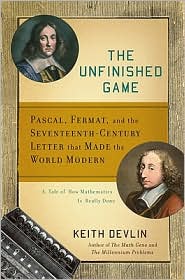
Every so often, I read a book about math. I couldn't really tell you why--call it a strange and inexplicable desire to understand how the world works on a level I don't spend much time on anymore (one semester of college calculus was enough for this liberal arts major, thank you very much), or call it pretension to a much broader intellect than I actually possess. I'm not sure, and I'm not willing to submit to analysis in order to find out. But the fact remains: a couple times a year, maybe, I read a book about math. And this time, it was Keith Devlin's The Unfinished Game, a decidedly not-for-mathematicians account of the roots and early development of probability theory. As math books go, it was in my opinion a particularly interesting one, taking as its basic unit of analysis and discussion a seventeenth century letter written by Blaise Pascal to Pierre de Fermat. Devlin's story doesn't stop there, of course (the book wouldn't have been too interesting if it had), but actually goes on to describe where probability went from there, and how it wound up even approximating the variety we're offhandedly familiar with today. Devlin alleges that this letter essentially marks a transformational point in man's evolution, at which s/he began to view the world in an entirely different and modern way. Prior to probability, Devlin alleges, the future was completely uncontrollable, entirely the realm of chance; afterward, it could be prepared for in certain ways, even predicted to a small extent. Without going into tremendous detail, I'll note that Devlin never had me entirely convinced, but was operating with a limited amount of text and without any extensive knowledge on my part of thought/behavior patterns of the 1600s, so I was willing to give him the benefit of the doubt. Did this book inspire in me the desire to actually develop an extensive knowledge of those patterns? Well, no. But it did teach me a lot about the genesis of modern probability theory that I didn't know--knowledge that may eventually come in handy at a bar quiz, especially pretentious dinner party, or some other occasion. So a B+ to you, Mr. Devlin, and a thank-you for making this math particularly readable.
09 September 2009
Zbigniew Brzezinski & Brent Scowcroft: AMERICA AND THE WORLD- CONVERSATIONS ON THE FUTURE OF AMERICAN FOREIGN POLICY (Moderated by David Ignatius)

Some might claim--and I don't know that I could really argue with them--that I tend to get stuck in ruts when it comes to reading material (it's unarguably true that I tend to get stuck in ruts under plenty of other circumstances, so I don't know if I'm even inclined to dispute this allegation). For a while there, I was only reading comic books; then only mid-20th century American noir; now, nonfiction books I checked out of the Free Library of Philadelphia (more on that later, by the way). To be fair, this has happened before, and I can account for it to a certain degree: it's not so much that I get stuck in a rut, as I finish a book and then, riding on the mood that it's put me in, select another book very much in the same vein to read next. It's perfectly logical, perfectly natural, but manifests itself in patterns that might appear to be all too unnatural. Anyway: the long and short of it is, I've started reading nonfiction books I found at the library (it's just down the street, now!), and can't say for certain when I'll stop. But you'll be sure to know when I do. Anyway... I must say, having read many nonfiction library books, that America and the World was particularly interesting. It's a series of conversations, moderated by Washington Post veteran reporter David Ignatius (who, it must be said, seems way out of his league [but whom is far closer to being in the right league than I would be, I'll be just as honest about that] in these discussions), between two of the late-Cold War's preeminent strategists. Former National Security Advisers Zbigniew Brzezinksi (Carter presidency...and we'll just call him Zbig from here on out) and Brent Scowcroft (George H.W. Bush [that's the first one] presidency) ostensibly approach the problems posed by Ignatius (and these problems touch on just about every continent's travails except Antarctica...and, to be honest, a fair portion of oft-forgotten Africa) from different ends of the political spectrum, but neither demonstrates the willful ignorance of fact that both major party platforms seem to generate among the political faithful. As a liberal progressive/social democrat myself, I expected to find myself agreeing with the Democrat Zbig far more than I did--but honestly, Scowcroft's arguments occasionally carried the day (largely because they're completely unreflective of the current state of diplomatic discourse in the Republican Party. More Scowcroft's, and the GOP might actually start presenting us with a legitimate alternative to wishy-washy Democratic foreign policy prescriptions). Most shocking of all, though, was how often the two alleged adversaries wound up agreeing, or dissenting in minor detail only. Simply because it's a reflection of the most thoughtful bipartisan discussion of foreign policy I've encountered in quite some time (and because it didn't devolve into the same manner of excessive parenthesization as this entry), I'm going to hand out an A for this one. Nice work, gentlemen.
08 September 2009
Theodore Sturgeon: THE NAIL AND THE ORACLE (Volume XI of the Complete Stories...)

Theodore Sturgeon, in my opinion, was one of the five-or-so best short story writers of the twentieth century, in English or any other language (I'd be hard pressed to spout off the other five, but I felt that calling him "the best" might be pushing it a little bit, and added them mostly for show). The Nail and the Oracle: Volume XI of the Complete Stories of Theodore Sturgeon doesn't happen to contain any of his very best work, but it does contain a lot of his better work, and is well worth reading for that reason alone (I told you, he's good). This isn't where I would start, had I never read Sturgeon before but was inclined to listen to my own advice about where to start reading Sturgeon (the previous conundrum may have contained a couple impossibilities, but let's forget them for a second, the way Sturgeon would've--forgotten them, or found a way around them. He was so damned creative, you see...). As an avowed Sturgeon fan, however (...and so magical, so original, so willing to take an idea and run with it, only it'd be an idea you'd've never had in the first place. Yes, that's it, he'd take ideas you never would've had in the first place to places you would've never thought to go with them), I thoroughly enjoyed myself. And while, interestingly enough, most of the actual writing in this post has been metadiscourse (the actual review [I give this book an A] has been largely contained within parentheses), I'd like to advance my opinion of it right now: The Nail and the Oracle contains second-rate work by a writer whose second-rate sails far above and beyond most people's first-rate. Theodore Sturgeon was a giant, a king of the short story, and remains one today. Reading his work is, for me, an act of love (still...no A+ for this volume. That A will have to do).
Subscribe to:
Posts (Atom)

 Posts
Posts


